Most advice treats load testing and stress testing as interchangeable exercises with different intensity settings. That framing is convenient, but it leads teams to run the same script twice, collect similar charts, and still miss the operational question that matters.
Load testing asks whether the system meets its performance targets under expected demand. Stress testing asks whether the system survives when demand exceeds those targets. One validates adequacy. The other exposes failure and recovery. The distinction appears in widely used testing taxonomies, including the ISTQB-aligned glossary, which separates expected concurrent users or transactions from testing beyond anticipated limits.
| Dimension | Load testing | Stress testing |
|---|---|---|
| Primary question | Does the system meet targets under expected traffic? | What breaks beyond capacity, and does the system recover? |
| Traffic model | Realistic expected or peak demand | Deliberate overload, resource constraint, or adversarial pattern |
| Pass criteria | Latency, throughput, errors, and headroom remain within targets | Failure is controlled, observable, and recoverable |
| Main result | Capacity evidence and performance baseline | Breaking point, failure modes, and recovery evidence |
| Operational decision | Can we launch or size this service for expected demand? | Can we survive an event, overload, or dependency failure? |
The difference affects the test plan, the dashboards, the safeguards, and the decision that follows. A green load test doesn't prove resilience. A stress test that turns the environment into an unexplained outage hasn't proved much either.
Table of Contents
- Why Teams Confuse Load Testing With Stress Testing
- What Load Testing Actually Validates
- What Stress Testing Actually Probes
- Side by Side Comparison of the Two Approaches
- Metrics That Matter for Each Test Type
- Real Scenarios That Decide Which Test to Run
- How to Choose the Right Test for Your Goal
- Common Questions About Load and Stress Testing
Why Teams Confuse Load Testing With Stress Testing
Load testing and stress testing often look identical in a test report. Both can use the same traffic generator, user journeys, application paths, and dashboards for latency, throughput, errors, and infrastructure utilization. The difference is not the tooling or the ramp. It is the operational question.
Load testing checks whether the system meets its targets under expected demand. You model production traffic, apply it consistently, and compare the result with defined performance objectives. The ISTQB-aligned distinction places load testing around anticipated concurrent users or transactions, while stress testing moves beyond those limits to examine failure and recovery.
Stress testing checks whether the system survives after those targets break. You exceed expected capacity, constrain a resource, or attack a failure domain to find the first limiting component. The useful question is whether overload causes controlled degradation, clear signals, and a credible return to normal operation. Response time still matters, but failure behavior and recovery become the primary evidence.
The success criteria therefore differ. A load test should produce a repeatable performance curve against targets and show whether the service has enough operating headroom. Gatling on load testing and stress testing describes the same separation: load testing examines the expected operating range, while stress testing identifies saturation and failure behavior.
Confusion starts because one user journey can support both tests. Login, search, checkout, and API transactions are valid workload choices for either plan. Reusing the journey is fine. Reusing the hypothesis is not. Increasing virtual users without changing the traffic shape, observability, safeguards, or exit criteria usually creates a louder load test, not a meaningful stress test.
Practical rule: If the decision is “can we support this demand,” run a load test. If the decision is “what happens after supportable demand is exceeded,” run a stress test.
The reporting language must follow that purpose. A service that stays available during a modest load test has not demonstrated resilience under overload. A stress run that returns errors has not automatically failed, because revealing errors may be the intended result. The useful report identifies which component failed, how the failure propagated, and whether recovery worked. This performance testing versus stress testing comparison provides a concise view of the distinction.
Teams get better decisions when they separate target validation from failure investigation before the test begins.
What Load Testing Actually Validates
Load testing answers a specific operational question: can the service meet its agreed targets under the demand it is expected to handle? That answer requires a defined workload and test boundary before traffic starts. Specify the user mix, concurrency or transaction volume, latency objectives, acceptable error rate, and infrastructure configuration under evaluation.
The traffic pattern should match the production behavior that matters. A gradual ramp can reach expected peak demand, followed by a plateau long enough to distinguish ordinary variation from a real bottleneck. The goal is a repeatable signal, not the most dramatic graph.
Build the test around a target
A useful load test has three parts:
- Workload model: Represent important journeys rather than only the easiest endpoint. Include authentication, reads, writes, background activity, and downstream calls when they affect the user transaction.
- Performance budget: Set latency percentiles, throughput, and error boundaries before the run. Percentiles expose a slow tail that an average can hide.
- Capacity context: Record the application version, data shape, instance configuration, database state, and scaling policy. Without that context, results are difficult to reproduce or compare.
The Gatling guidance on load testing recommends evaluating performance against a target curve instead of treating one response-time value as the complete result. Engineers can then see whether latency stays stable, rises gradually, or bends sharply as demand nears saturation.
A passing run shows that the system meets its agreed objectives under the modeled workload. It should also show usable resource headroom. A service that barely clears the threshold may remain fragile during ordinary variation, even when the formal result is green.
What the result lets you decide
Load testing supports decisions about launch readiness, instance sizing, query optimization, caching, connection limits, and autoscaling configuration. If throughput stops increasing while demand continues to rise, the test has exposed a capacity constraint, even if some individual requests remain fast.
The result is bounded by the range tested. It does not establish how queues behave after saturation, whether circuit breakers activate, or whether a dependency failure still permits recovery. A green load test demonstrates adequacy for the modeled workload. It does not demonstrate survival after that workload exceeds the service's operating target.
What Stress Testing Actually Probes
Stress testing asks a different operational question from load testing: can the system survive after its performance targets fail? The test pushes the service beyond its expected operating envelope by ramping traffic past the anticipated peak, creating a sharp surge, exhausting a connection pool, constraining I/O, or isolating a dependency. Choose the method from a specific failure hypothesis, then observe the breaking point and the behavior around it.
A stress run must stay controlled. Define the test boundary, identify every system that may receive traffic, set abort conditions, and ensure operators can distinguish test traffic from a real incident. Authorized scope matters especially when the exercise reaches external providers or network defenses.
Failure is part of the result
Stress testing can reveal:
- Cascading timeouts: A slow dependency consumes threads or connections until upstream requests fail.
- Queue backlogs: Producers continue submitting work after consumers reach saturation.
- Circuit-breaker behavior: Protection trips too late, too early, or not at all.
- Graceful degradation: Read-only modes, cached responses, fallback providers, or reduced functionality preserve critical paths.
- Data integrity risks: Retries, partial writes, duplicate messages, and rollback behavior behave differently under failure.
A green dashboard is not the success condition. A useful stress exercise identifies the saturation threshold, records the first bottleneck, and shows whether the service fails within a bounded and observable scope. It should also reveal which protections activate, which requests are rejected, and whether dependent components remain isolated.
Recovery must be tested deliberately
Reducing traffic starts recovery validation, but it does not complete it. Monitor whether queues drain, connections become available, rejected work stops propagating, and dependent services return to a healthy state. Check that normal processing resumes without hidden backlog, duplicate work, or inconsistent data.
Recovery evidence should support an operational decision. Can the system shed load without taking down unrelated paths? Does autoscaling respond within the required window? Do operators need to intervene, or does the service stabilize on its own? These answers distinguish a controlled overload from a wider incident.
The test should include an intentional recovery period and clear exit conditions. Record the time and actions required to restore service, then inspect logs, queue state, error classes, and downstream health after traffic returns to normal. Stress testing therefore evaluates failure and recovery behavior, not merely the point where latency exceeds the target.
Side by Side Comparison of the Two Approaches
A stakeholder doesn't need two similar charts. They need to know what decision each test supports, what evidence it will produce, and what the team must do if the result isn't acceptable. The comparison below focuses on those practical differences.
Load Testing vs Stress Testing Operational Comparison
| Dimension | Load Testing | Stress Testing |
|---|---|---|
| Objective | Verify performance under expected production demand | Identify the breaking point and validate failure and recovery behavior |
| Traffic profile | Realistic, deterministic, steady or ramped toward expected or peak demand | Deliberately beyond expected demand, sharply spiked, resource-constrained, or dependency-focused |
| Primary posture | Protect the performance contract | Challenge the system's limits |
| Pass criteria | Latency, throughput, error rate, and resource headroom remain within agreed targets | The system fails in a bounded, observable way and recovers according to the resilience requirement |
| Core metrics | Percentile latency, throughput, errors, saturation, and capacity headroom | Saturation threshold, error classes, failure order, queue behavior, and recovery behavior |
| Typical duration | Often long enough to establish a clean steady-state signal, with the exact duration determined by the workload and objective | May use a short overload spike or a controlled failure window, followed by an intentional recovery period |
| Main deliverable | Capacity baseline, target comparison, bottleneck findings, and launch or sizing recommendation | Breaking-point evidence, failure cascade, recovery result, and resilience gaps |
| Operational decision | Can the service support the expected demand? | What must protect the service when expected demand is exceeded? |
The traffic-profile row matters because realism is the foundation of a load test. If the test sends an unrealistic request mix, a passing result can describe the generator rather than the product. Stress testing has a different requirement. Its traffic can be abnormal by design, but it still needs a reason, such as validating rate limiting, queue protection, or dependency isolation.
The metric row also changes interpretation. Load testing asks whether a percentile stays inside the target while demand follows the expected curve. Stress testing asks where the curve changes shape, which errors appear first, and whether the system returns to a usable state after overload.
Choose the deliverable before the script
Write the decision statement before writing the scenario. For a release review, the output might be a capacity recommendation and a target comparison. For a resilience review, it might be a failure map with recovery actions. A structured SRE reliability review template from SpecStory, Inc. can help teams record the operational context, evidence, risks, and follow-up work rather than filing a graph without a decision.
Running one script twice doesn't create both kinds of evidence. Keep the shared user journeys if they represent real behavior, but separate the workload profile, thresholds, stop conditions, and report format.
Metrics That Matter for Each Test Type
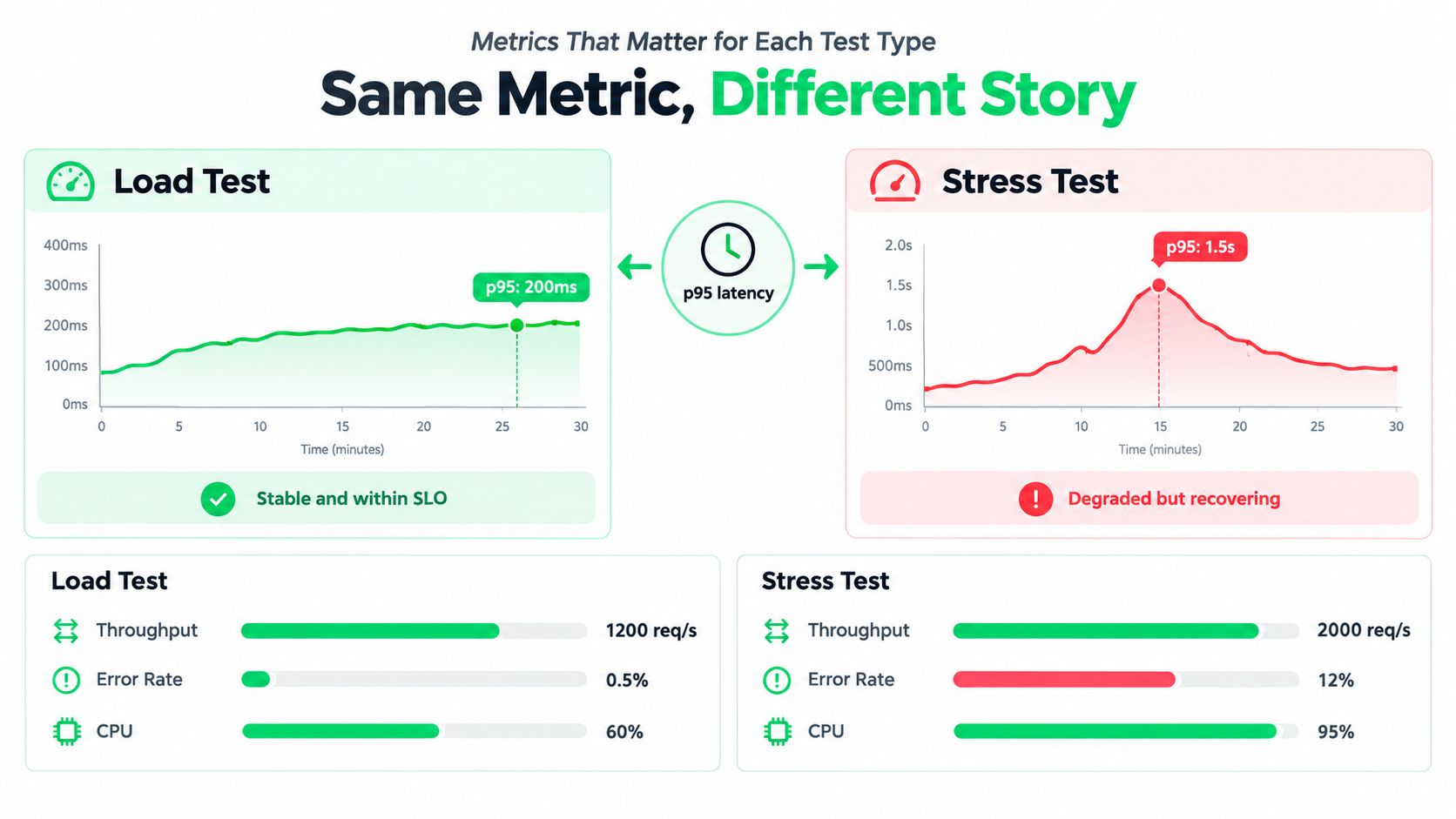
The same graph can support opposite decisions. Load testing asks whether the service meets targets under expected demand. Stress testing asks where those targets fail, what breaks first, and whether the system recovers after overload.
Percentile latency
For load testing, p95 and p99 latency show whether the slowest meaningful requests remain within the service objective at expected peak demand. Watch for a stable curve after the workload settles. Gradual deterioration usually points to contention, insufficient capacity, or a queue that keeps growing.
Stress testing puts less weight on the final latency value and more on the curve's behavior. Identify where latency begins to rise sharply, whether it keeps increasing after throughput stops growing, and how quickly it moves back toward normal when demand falls. The example values in the infographic are illustrative, not production benchmarks.
Throughput
Load testing uses throughput to confirm that the system can process the required request or transaction rate without saturation. If throughput tracks rising demand while latency remains controlled, the service is meeting its expected operating target.
Stress testing uses throughput to find the service ceiling. QASphere's performance-testing guidance explains that rising load with flat throughput indicates saturation rather than added capacity. A drop under overload becomes useful evidence when paired with resource and error data that identify the constraint.
Error rate
In a load test, errors usually act as a release gate. A quick response is not a pass if the application rejects requests, returns incorrect fallback content, or conceals downstream failures. Separate client errors, server errors, timeouts, and dependency failures so the release decision reflects the actual risk.
In a stress test, errors help map the failure mode. Their order matters. Validation errors, timeouts, connection refusals, queue rejections, and server failures point to different controls and recovery work. Check whether the system sheds noncritical work before critical paths fail.
Resource saturation
CPU and memory rarely explain the entire incident. Monitor connection pools, file descriptors, I/O, queue depth, garbage collection, database connections, and network behavior alongside host utilization. A performance-testing discussion from QASphere identifies these as possible first bottlenecks.
For load testing, saturation metrics show headroom and support capacity planning. For stress testing, they reveal the first constrained resource and how that constraint spreads through the stack. Correlate application telemetry with infrastructure data. Otherwise, the report can show that the service failed without showing why.
Real Scenarios That Decide Which Test to Run
The right test follows the decision, not the calendar. A team preparing a launch needs different evidence from a team validating overload protection, even when both teams use the same HTTP workload generator.
A SaaS re-platform
A SaaS team moving to a new infrastructure stack should start with a load test based on projected peak customer activity. The objective is to verify that key workflows meet their performance targets and to determine whether the planned launch capacity provides usable headroom.
The test should keep the workload realistic. A synthetic user who only requests a health endpoint won't validate the database, cache, authorization, or background interactions that shape the actual customer experience. Once the target run is understood, a separate stress exercise can investigate what happens if adoption outpaces the projection.
A retail promotion
A retail platform preparing for a major promotion needs both forms of evidence, but they answer different questions. Load testing validates the expected browsing, cart, and checkout mix. Stress testing pushes beyond that forecast to observe queue overflow, inventory contention, payment dependency behavior, and the point at which protective controls should shed work.
The operational decision isn't whether the site can serve a forecast. It's whether the platform can protect checkout and recover when demand exceeds the forecast. Teams should validate scaling triggers and customer-facing fallback behavior under controlled conditions, not discover them during the sale.
A financial API and its edge controls
A financial API hardening its rate limiting or DDoS mitigation needs a stress plan focused on traffic shapes that test the boundary controls. Bursts, uneven client behavior, and pressure on a single endpoint can reveal whether the edge layer absorbs or rejects unwanted demand before the application and its dependencies become unstable.
The result should identify which requests are shed, which critical paths remain available, and whether circuit breakers and downstream protections reset correctly. The team also needs an authorized scope and an operator-led abort process. The legal stress-testing scope guide is useful when defining ownership, permissions, traffic boundaries, and stop conditions before the exercise.
A multiplayer game event
A multiplayer game server preparing for an extended weekend event needs more than a single overload run. A soak test is appropriate for finding memory leaks, connection exhaustion, and gradual degradation during sustained normal demand. A load test validates regional concurrency targets and critical match flows.
Stress testing then addresses the failure case. Increase pressure on a shard or matchmaking path until its protective behavior appears, and verify that players receive a controlled fallback rather than a system-wide collapse. The decision is whether the platform can isolate a saturated shard and restore service without corrupting session or match state.
How to Choose the Right Test for Your Goal
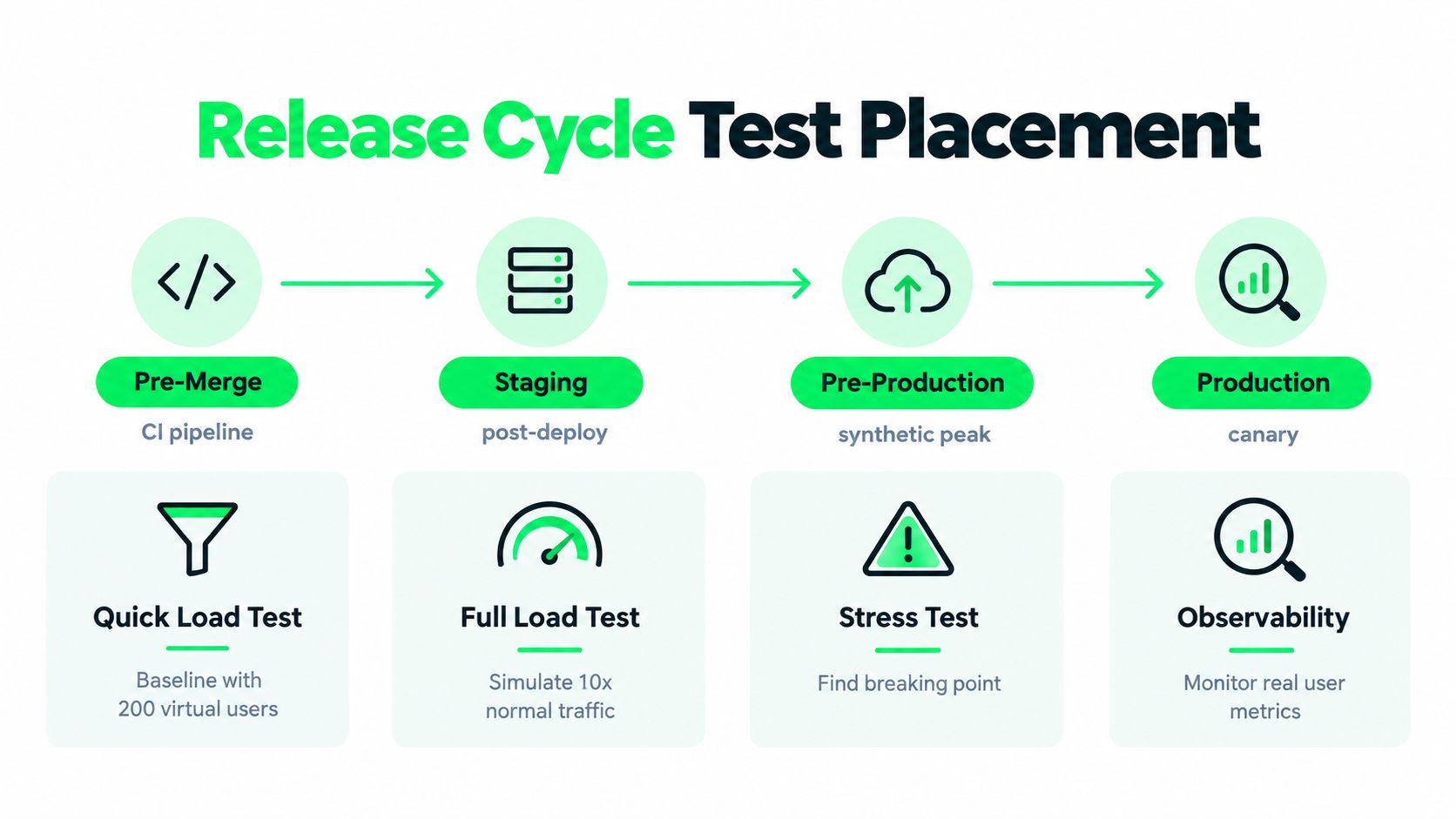
Don't choose between load testing and stress testing as if they're competing products. Place them at different points in the release and reliability cycle.
Run load tests whenever the workload or code path changes materially. That can include a new release, a database query change, a caching adjustment, a deployment configuration change, or a capacity decision. Lightweight checks can provide regression feedback early, while production-like runs give the release team stronger evidence before launch.
Stress tests need tighter planning because they intentionally create failure conditions. Schedule them before a known demand event, after an architecture change that introduces a new failure domain, and whenever you need evidence for graceful degradation, rate limiting, autoscaling, or recovery. Don't run them casually against shared production systems.
Decision rule: If you can't state the target throughput and latency budget, run load testing first. If the targets are met but failure behavior remains unproven, run stress testing next.
Keep the plans distinct
Shared infrastructure and tooling are fine. Shared pass criteria are not. A load plan should stop or fail when the performance contract is violated. A stress plan should continue through a controlled overload window, capture the failure sequence, then reduce demand and measure recovery.
Tool selection should follow protocol coverage, scripting model, observability integration, and governance. Teams comparing API-oriented options can use this guide to choosing an API load-testing tool. For authorized infrastructure validation, RETRO//STRESS provides Layer 4 and Layer 7 testing, packet-chain replay, a web interface, REST API, and CLI controls for repeatable and automated exercises.
The release cycle doesn't end when the test stops. Feed results into dashboards, incident reviews, and backlog items. Production observability confirms whether the assumptions in the test model still match user behavior.
Common Questions About Load and Stress Testing
Does soak testing overlap with stress testing? Not in objective. Soak testing applies normal or expected load for a long duration to expose memory leaks, resource exhaustion, and gradual degradation. Stress testing exceeds capacity to expose breaking points and recovery behavior.
Should both run before every launch? For a user-facing release with material traffic, load testing should be part of readiness validation. Add stress testing when failure behavior, overload protection, or recovery matters to the launch risk.
Can both tests share tools and infrastructure? Yes, but keep the plans separate. Their traffic profiles, thresholds, exit conditions, and reports differ enough that bundling them into one run makes the evidence harder to interpret. Use the same workload components where practical, then change the hypothesis and controls for each test.
RETRO//STRESS supports authorized infrastructure resilience validation through Layer 4 and Layer 7 load testing, packet-chain replay, geographic test selection, live monitoring, REST API automation, and CLI control. Use RETRO//STRESS to turn representative traffic and incident traces into repeatable load and stress exercises, then make capacity and recovery decisions from evidence rather than assumptions.