The right DDoS test isn't the one that throws the most traffic. That's the most common bad advice in this category, and it leads teams to buy the wrong thing, run unsafe exercises, and still miss the failure mode that matters.
Authorized DDoS validation is a broader practice than most "best tools" lists admit. Sometimes you need lab emulation that lets engineers reproduce protocol behavior in a controlled environment. Sometimes you need continuous, non-disruptive assessment against a live edge. Sometimes the right answer is a managed simulation with cloud and ISP coordination, or a mitigation-provider validation that proves routing, diversion, and scrubbing workflows. And sometimes the only useful test is capture-to-replay, where you turn a real incident pattern into a deterministic regression case.
That framing matters because DDoS testing has always depended on repeatability, observability, deployment control, and replay. A 2010 IFIP paper described those capabilities as baseline requirements for DDoS experimentation, not optional extras, and it also set out the foundational split between simulation, emulation, and real-system testbeds in its discussion of DDoS testbed design.
So this list doesn't rank tools by raw flood size. It evaluates DDoS testing tools by operational fit: Layer 4 and Layer 7 scope, realism, replay fidelity, automation, geographic distribution, governance controls, reporting, and how safely each option fits into an approval-driven workflow.
Table of Contents
- 1. RETRO//STRESS
- 2. Keysight BreakingPoint
- 3. Spirent CyberFlood
- 4. Red Button
- 5. MazeBolt RADAR
- 6. RedWolf Security
- 7. NimbusDDOS
- 8. Akamai Prolexic
- 9. Vercara UltraDDoS Protect
- 10. DDoS-Simulation.com
- Top 10 DDoS Testing Tools Comparison
- Choose the Test Model That Matches the Risk
1. RETRO//STRESS
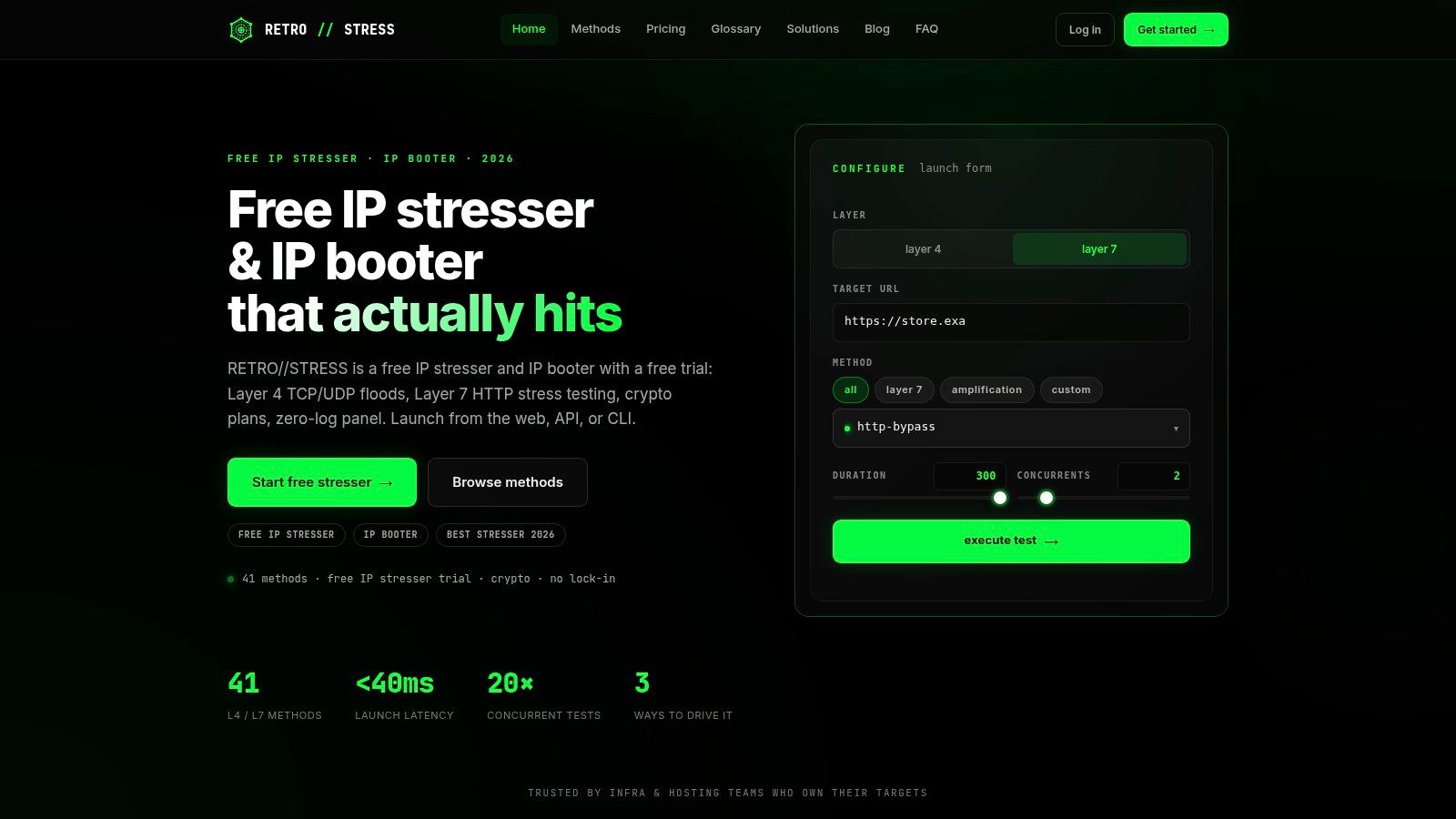
RETRO//STRESS is the strongest fit here when the job isn't "generate a lot of packets" but "reproduce the incident shape, then prove the fix." That sounds obvious, but many DDoS testing tools still push users toward generic floods and slider-based load patterns that don't capture packet timing, flag combinations, or step-by-step request sequencing.
RETRO//STRESS is built around authorized stress testing of infrastructure you own or are explicitly permitted to test. It covers Layer 4 and Layer 7 methods, but the more important distinction is its capture, chain, and replay model. You can record traffic from desktop, CLI, or mobile, import PCAPs, convert them into portable .chain v1.3 files, store those artifacts in version control, and rerun them when code, edge rules, or provider settings change.
Where it stands out
The packet-chain model is what separates it from many cloud stress tools. Operators can define per-step flags, payloads, delays, and header-related overrides for deterministic tests that are much closer to protocol exercise than generic load generation. That makes it useful for edge cases like validating scrubbing changes after a UDP-heavy incident, reproducing application handshake pressure, or checking whether a mitigation rule breaks legitimate request flows under stress.
The same engine is exposed through a web panel, REST API, and CLI, which means the test you prototype manually can become part of an automated deployment gate. If you want to start from the practical workflow rather than discover it by trial and error, the RETRO//STRESS getting started documentation is the right entry point.
Practical rule: If you can't save and replay the test that revealed the weakness, you probably haven't built a validation program yet. You've run a one-off event.
Best fit and trade-offs
RETRO//STRESS also handles global traffic origination, scheduling, audit logging, token-based automation, and governance features that matter in real environments. The platform follows an authorized-use model and a privacy-first design, including a zero-log posture, which is the right approach for teams that need validation without turning test history into another exposure point.
Its limitations are mostly the trade-offs of precision. Packet-level control, PCAP workflows, and reusable chains are more powerful than simple load dashboards, but they require more operator judgment. Procurement can also be a factor for organizations that expect traditional enterprise buying paths.
- Best for incident fidelity: Replaying captured patterns instead of approximating them.
- Best for automation: CI/CD integration through API and CLI, using the same underlying engine as the web panel.
- Watch for complexity: Teams used to one-click load tools will need a clearer test design process.
- Non-negotiable safeguard: Only use it against assets you own or are explicitly authorized to test.
2. Keysight BreakingPoint
Keysight BreakingPoint is a classic enterprise choice for teams that want deep lab and cloud emulation across Layer 3 through Layer 7. It isn't the first tool I'd choose for ad hoc production exercises, but it's one of the stronger options when you need repeatable pre-production validation of controls, devices, and mitigation policy changes.
Its biggest advantage is packaged test content. BreakingPoint includes protocol, application, and attack libraries with prebuilt methodologies that cut down setup time. For teams comparing appliance behavior, validating firmware changes, or checking whether a cloud DDoS control reacts the same way after a policy update, that curated content matters more than novelty.
Where it fits operationally
BreakingPoint Cloud adds elastic deployment and distributed agents, which helps when you need cloud-oriented validation rather than a pure hardware-lab exercise. That makes it useful for modeling attacker distribution patterns in controlled ways before anyone touches a live production edge.
This category also benefits from a broader reminder from DDoS research. A later benchmark-oriented workbench was designed specifically to report DDoS impact in real time and scale to large networks, reflecting the long-running need for deterministic regression and capacity validation rather than headline traffic generation alone, as described in Purdue's benchmark methodology and Reval workbench paper.
For teams validating defense logic rather than attack theatrics, this guide to defense validation testing is a useful companion mindset.
- Best for controlled emulation: Strong in lab and cloud environments where repeatability matters.
- Best for comparison testing: Helpful when you need to compare vendor configurations or policy revisions.
- Less ideal for live production runs: You still need approvals, stop conditions, and stakeholder coordination.
3. Spirent CyberFlood
Spirent CyberFlood is usually at its best when a team wants DDoS testing as part of a broader security and performance validation program. If BreakingPoint often feels like a security attack emulation anchor, CyberFlood tends to appeal to teams that also care about realistic application mixes, capacity baselining, and adjacent regression work.
Its TestCloud content is the practical draw. You get a vendor-neutral platform for emulating both legitimate user behavior and hostile traffic across Layer 4 through Layer 7, which is useful when the hard question isn't "Will the box survive?" but "What breaks first when mitigation turns on and normal users are still trying to transact?"
What it does well
CyberFlood is a good fit for validating devices, data centers, and service architectures before production rollout. It also helps when you want to compare CDN, WAF, or scrubbing behavior under stress without tying the exercise to a single mitigation provider's worldview.
The limitation is familiar. Good test content doesn't remove the need for good scenario design. Multi-tier production stacks, API gateways, hybrid traffic paths, and application-specific session behavior still require engineers who understand what to model and what to measure.
The most expensive DDoS test is the one that confirms your lab can survive traffic patterns your production users will never generate.
Use CyberFlood when you need realistic emulation under controlled conditions. Skip it if what you really need is a provider-coordinated production rehearsal with routing approvals and operational runbooks.
4. Red Button
High traffic rates are the least interesting part of a production DDoS test. The hard part is running one without creating an incident yourself.
Red Button fits teams that need live-environment validation and want an external operator to control the workflow end to end. That changes the testing model. Instead of renting a platform and building scenarios internally, you define scope, approvals, abort conditions, observability, and success criteria with a provider that runs the exercise for you.
That model has clear operational value when the target path crosses multiple owners. Internet transit, CDN policy, cloud edge controls, scrubbing contracts, origin protections, and on-call procedures all need to line up before the first packet is sent. A managed service is often the safer choice when those dependencies are the main risk.
The practical question is fit. Red Button is stronger for rehearsed production events than for frequent lab iteration or ad hoc engineering checks. If the goal is to verify that mitigation providers, routing policy, and incident response workflows behave correctly under controlled pressure, this approach makes sense. If the goal is weekly regression testing against app changes, a self-service platform is usually a better match.
Scope definition matters more than brand names here. Teams should decide upfront whether they are validating Layer 4 handling, Layer 7 behavior, mixed attack paths, replay of known bad traffic, or the handoff between automated mitigation and human escalation. They also need explicit stop rules, protected time windows, stakeholder approvals, and telemetry that can distinguish blocked attack traffic from collateral impact on legitimate users.
Red Button's value sits in that governance layer as much as in the simulation itself. The company also frames the gap many defenders still have between nominal coverage and tested coverage in Red Button's discussion of testing gaps in modern mitigation.
Use it for supervised production rehearsal. Skip it if you need fast, repeatable experimentation under your own control.
5. MazeBolt RADAR
Many DDoS programs do not fail because the team skipped a dramatic production exercise. They fail because protections drift between releases, DNS changes, CDN policy edits, and mitigation-provider updates. MazeBolt RADAR is built for that problem.
Its testing model is narrower than a full attack simulation, but operationally useful. RADAR is aimed at continuous validation of internet-facing exposure and control alignment in live environments, with an emphasis on finding weaknesses without creating a disruptive event. For teams responsible for always-on services, that changes the approval path. A low-impact validation workflow is easier to run regularly than a scheduled stress exercise that needs broad sign-off and a protected maintenance window.
The fit is strongest at the edge. RADAR makes more sense for checking whether Layer 3 and Layer 4 protections are present, reachable, and configured as expected across CDN, WAF, scrubbing, and cloud components than for recreating a nuanced Layer 7 application attack with high replay fidelity. If the question is "Are we exposing the paths we think we protected?" this model is useful. If the question is "Will this exact bot pattern trigger the same mitigation and response sequence we saw during the last incident?" another tool category is a better match.
That distinction matters in practice.
Teams using RADAR still need controls around scope, provider authorization, alert suppression, and success criteria. The measurements are also different from a supervised flood test. Focus on exposure findings, control mismatches, remediation time, repeat validation, and whether changes in edge policy reopen previously closed paths. Do not expect geographic realism, full packet choreography, or human runbook rehearsal to be the main output.
MazeBolt is a good choice when governance and continuous assurance matter more than event-scale simulation. It is a weaker choice for incident replay, deep L7 behavior testing, or automation pipelines that need repeatable traffic generation against pre-production builds.
6. RedWolf Security
RedWolf Security sits in a useful middle ground between platform and service. Some teams want a guided exercise with experienced operators involved. Others want more self-service control without building an entire test capability in-house. RedWolf's model fits that split reasonably well.
Its appeal is flexibility. Organizations can use external simulation support, reusable scenarios, and advisory input without committing immediately to a pure managed-service model or a heavy enterprise lab stack. That can help teams with growing maturity who know they need DDoS validation, but haven't settled on a permanent operating model.
Where it's practical
RedWolf is particularly relevant when the target is a layered edge made up of CDN, WAF, cloud, and origin controls, and the team wants help designing scenarios that exercise those components together. That's often more valuable than simple attack breadth because the failure usually happens in the seams between controls.
The trade-off is that live simulation still requires the same discipline as any other production test. Scope, provider permissions, stop thresholds, routing awareness, and response contacts all need to be nailed down before anyone starts.
Don't confuse self-service with self-authorizing. If the test crosses cloud, CDN, or transit boundaries, approvals still matter.
Choose RedWolf when you want room to blend internal ownership with expert guidance. Look elsewhere if you need a tightly integrated lab platform or a mitigation provider's built-in validation path.
7. NimbusDDOS
A high-volume test can still be a poor validation exercise. NimbusDDOS is more useful when the question is operational fit: can the team rehearse a controlled event, observe the right signals, and leave with changes to thresholds, runbooks, and escalation paths that reduce risk?
That makes it a better match for organizations treating DDoS testing as a preparedness program rather than a one-off stress event. The practical value is in supervised execution, cautious scope control, and the link between the traffic model and the response workflow.
NimbusDDOS fits best when the target includes internet-facing services that need live validation but cannot absorb a loosely governed test window. I would put it in the bucket for production-oriented exercises with explicit approvals, rollback criteria, and success measures defined before the first packet is sent. For L7 scenarios, that usually means agreeing on request patterns, rate ceilings, cache behavior, and the telemetry that marks user impact. For L4 work, the discussion shifts to edge capacity, upstream coordination, and whether the purpose is to test mitigation engagement or confirm that protection triggers fire as expected.
A buyer should ask different questions here than they would for a lab platform. How much replay fidelity is available? Can the exercise be automated and repeated after policy changes? How realistic is the source distribution if geographic behavior matters? Who owns governance during the event, and who has authority to stop it?
Public materials suggest a conservative delivery model, which is often the right trade-off. It reduces the chance that the test becomes the incident. The downside is less obvious self-service depth than teams may get from a dedicated internal platform or a pure emulator.
NimbusDDOS is a sensible choice for mature change-controlled environments, especially where security and operations want a guided path from simulation to remediation. It is less attractive for teams that need frequent autonomous testing, heavy CI-driven automation, or broad protocol experimentation inside their own lab.
8. Akamai Prolexic
Akamai Prolexic fits a narrower testing model than the lab tools in this list. The value is not packet generation by itself. The value is proving that your mitigation path works in production conditions, with the provider involved, before an actual event forces the issue.
That distinction matters.
Teams usually reach for Prolexic validation when the open questions are operational. Will traffic divert the way the design says it should? Will the scrubbing workflow preserve legitimate sessions at L7? Will L4 protections trigger cleanly without creating confusion between your NOC, SOC, and Akamai's team? Those are service-path questions, and they are hard to answer with an internal emulator alone.
The trade-off is obvious once you frame it that way. You get realistic validation of routing, handoff, and mitigation behavior inside the provider relationship. You give up some autonomy, replay flexibility, and test frequency compared with a platform your own team controls.
I would treat Prolexic as a governed exercise, not a general-purpose DDoS testing tool. A useful test plan here starts with approvals, stop conditions, source scope, rate ceilings, and the exact telemetry that defines success or user impact. For L7 scenarios, that often means agreeing on URL patterns, session handling, cache interaction, and what counts as acceptable degradation. For L4 scenarios, it usually means confirming diversion mechanics, mitigation engagement, upstream awareness, and post-test evidence that the control path behaved as expected.
The reporting matters as much as the traffic. A supervised event should produce enough evidence to tune thresholds, revise runbooks, and settle any disagreement about whether a policy change improved resilience. Teams that are preparing those changes can use a more detailed planning framework in this breakdown of validating mitigation changes under load.
Prolexic is a strong fit for organizations that already depend on Akamai for scrubbing and want controlled validation of that exact delivery model. It is a weaker fit for buyers looking for self-service experimentation, CI-driven repetition, or broad protocol testing across lab and non-Akamai environments.
9. Vercara UltraDDoS Protect
Vercara UltraDDoS Protect belongs in this list for the same reason Akamai does. Mitigation providers that publish a clear stance on authorized testing are more useful than providers that force customers to infer what is and isn't allowed.
That clarity matters because production DDoS validation isn't just a technical exercise. It affects contractual boundaries, SOC workflows, routing behavior, and customer support paths. A provider that supports scheduled, authorized simulations gives operations teams a cleaner way to prove the service rather than trusting onboarding assumptions forever.
Operational fit
UltraDDoS Protect is best for customers who want to validate runbooks, routing, and scrubbing behavior within an existing mitigation relationship. The right test in that setting usually isn't "Can I outgun the network?" It's "Will the provider detect the event, divert correctly, scrub effectively, and leave legitimate traffic usable?"
There's also a broader market signal behind this category. The global DDoS protection and mitigation market was valued at USD 4.18 billion in 2025 and is projected to reach USD 10.69 billion by 2034, according to the market figure cited in the ACM-linked reference provided for this article. That doesn't tell you which tool to buy, but it does explain why validation workflows around commercial mitigation services now matter so much.
Use Vercara when provider coordination is part of the point. Skip it if you need an independent replay, lab, or self-service simulation platform.
10. DDoS-Simulation.com
Buying more traffic is rarely the hard part. The harder question is whether a test model fits the system you need to validate.
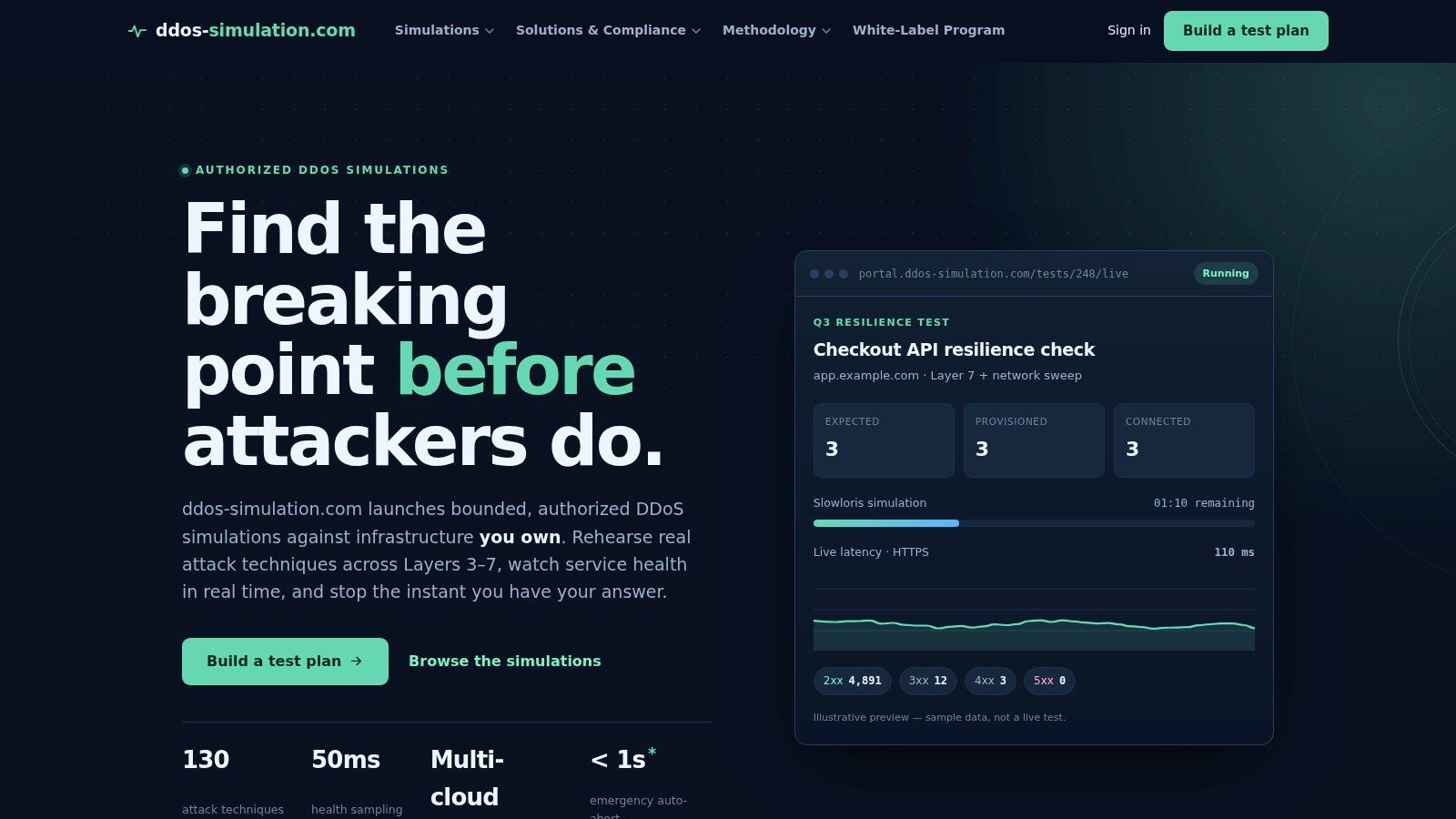
DDoS-Simulation.com sits in the middle ground between enterprise lab platforms and mitigation-provider exercises. That makes it relevant for teams that need a live rehearsal with tighter scope, especially when the goal is to check a specific control path instead of running a broad program across every layer.
The operational fit is strongest when the test question is concrete. Can an L7 ruleset absorb a hostile request pattern without breaking checkout or login? Does a CDN policy keep origin exposure contained under repeated bursts? Can an API edge maintain acceptable latency while rate limits, bot controls, and upstream dependencies all react at once? For that kind of work, guardrails matter more than headline volume.
One practical strength here is the emphasis on abort logic tied to service health. If latency, error rates, or HTTP behavior move outside the agreed threshold, the exercise stops. That is useful in production-adjacent environments where the team wants evidence, not heroics.
There are trade-offs.
Independent simulation services can be easier to schedule than a large enterprise engagement, but buyers still need to verify what kind of testing is being offered. Ask whether the model is packet or request generation, how much L4 versus L7 coverage is available, whether scenarios can replay captured behavior or only use preset patterns, and how much geographic distribution is real versus nominal. Those details determine whether the result will help SecOps tune controls, help SRE validate user impact, or confirm that a target can receive traffic.
A careful implementation path usually looks like this:
- define the exact layer and success criteria before scheduling
- get written authorization for targets, time windows, and upstream stakeholders
- set abort thresholds for latency, error rate, origin health, and support triggers
- capture measurements from both the application side and the mitigation side
- run a small calibration event before the main exercise
Use DDoS-Simulation.com for bounded validation where governance and stop conditions need to be explicit. Look elsewhere if you need high-fidelity replay, heavy automation, broad global realism, or a lab-grade platform for repeatable L4 through L7 benchmarking.
Top 10 DDoS Testing Tools Comparison
| Solution | Core features | Unique / USP | Target audience | UX ★ / Pricing 💰 |
|---|---|---|---|---|
| RETRO//STRESS 🏆 | L4/L7 (41 methods); capture → .chain; global multi‑worker | ✨ Deterministic packet‑level replay; open .chain; privacy‑first 🏆 | 👥 SRE/DevOps, SecOps, hosting, game ops, fintech | ★★★★☆ / 💰Tiers (Guest→Enterprise), free trial, crypto |
| Keysight BreakingPoint | L3–L7 traffic & threat emulation; BreakingPoint Cloud | ✨ Rich protocol libraries & QuickTests for fast setup | 👥 Enterprise labs, vendors, security validation teams | ★★★☆☆ / 💰Enterprise licensing (HW/SW) |
| Spirent CyberFlood | L4–L7 test cloud; volumetric & protocol DDoS | ✨ TestCloud app/attack library for device & capacity baselining | 👥 Carriers, device vendors, pre‑prod teams | ★★★☆☆ / 💰Enterprise pricing |
| Red Button (managed) | End‑to‑end scoped simulations; approvals & aborts | ✨ Hyperscaler authorization paths; tight runbooks | 👥 Teams wanting fully managed, production‑safe sims | ★★★★☆ / 💰Engagement‑based (service fee) |
| MazeBolt RADAR | Continuous, non‑disruptive probing; 150+ vectors | ✨ Ongoing SmartCycle insights & non‑disruptive methodology | 👥 Enterprises needing continuous validation & governance | ★★★★☆ / 💰Subscription |
| RedWolf Security | Self‑service or guided simulations; advisory | ✨ Mix of DIY + expert guidance; Azure partner recognition | 👥 Mixed‑maturity teams; regulated sectors | ★★★☆☆ / 💰Service or subscription |
| NimbusDDOS | Managed exercises; ramped traffic & workshops | ✨ Operational readiness focus; KPIs & runbook dev | 👥 Teams seeking preparedness, training, conservative tests | ★★★★☆ / 💰Engagement‑based |
| Akamai Prolexic (validation) | Global scrubbing + SOC; provider‑supervised tests | ✨ Large scrubbing network; supervised routing/validation | 👥 Large enterprises on Prolexic; SOC‑backed customers | ★★★★☆ / 💰Part of mitigation contract |
| Vercara UltraDDoS Protect | High‑capacity scrubbing; APIs & test policy | ✨ Published test policies & enterprise SLAs | 👥 Enterprise mitigation customers | ★★★★☆ / 💰Engagement/contract dependent |
| DDoS‑Simulation.com | Independent L3/L4/L7 scenarios; health guardrails | ✨ Surgical rehearsals with auto‑abort SLOs | 👥 Teams needing targeted, fast simulations | ★★★☆☆ / 💰Pay‑per‑test / smaller provider |
Choose the Test Model That Matches the Risk
The right way to choose among DDoS testing tools is to start with the failure mode, not the traffic source. If you need controlled protocol and application emulation across Layer 3 through Layer 7, use a lab-focused platform like Keysight BreakingPoint or Spirent CyberFlood. They give you repeatability, controlled baselines, and room to compare configuration changes before anything touches production.
If incident fidelity matters most, capture-to-replay is the better model. That's where a platform like RETRO//STRESS has a clear advantage. Turning observed traffic into a replayable artifact is often more useful than designing a synthetic flood from scratch, especially when the outage involved odd packet timing, specific handshake behavior, or an application path that generic load tools won't mimic well.
Use continuous validation when disruption isn't acceptable. MazeBolt RADAR fits organizations that need ongoing checks against drift across CDN, WAF, and scrubbing layers, and where maintenance windows are politically or operationally expensive. The trade-off is that non-disruptive validation usually won't replace a full-fidelity incident recreation or a provider-supervised routing event.
For production routing, scrubbing, and operational response, managed simulations and mitigation-provider exercises are often the safest path. Red Button, RedWolf Security, NimbusDDOS, Akamai Prolexic, Vercara UltraDDoS Protect, and DDoS-Simulation.com all fit versions of that need, but with different levels of independence, service involvement, and governance support.
The common controls should be the same in every model. Get written authorization. Confirm cloud-provider, mitigation-provider, CDN, and ISP approvals where applicable. Define stop conditions before the first packet leaves the generator. Assign named rollback contacts with phone numbers, not just ticket queues. Monitor KPIs that reflect the whole defense chain, including detection, mitigation behavior, legitimate-user impact, and recovery, not only whether an endpoint stayed reachable.
A recent systematic review of SDN DDoS research noted that hping3 remains the standard benchmark generator for high-volume flooding scenarios, appearing in roughly 45% of surveyed studies, and that researchers commonly pair it with Tcpdump and Wireshark for packet capture and feature validation. The same review also found that about 35% of studies use public datasets, with CICDDoS2019 and CICIDS2017 appearing in roughly 30 to 40% of papers as a dominant comparability baseline, according to the benchmark study reference cited for this article. That academic pattern is a useful reminder. Good testing programs combine traffic generation, observation, and comparability. They don't rely on one dramatic event.
Finally, review the test after it ends. Record what failed, what nearly failed, what was noisy, what operators missed, and what changed. Then rerun the exercise after remediation. A DDoS test is only valuable when it becomes part of a repeatable validation cycle.
If you need incident-faithful, authorized validation rather than another generic flood tool, RETRO//STRESS is built for that workflow. It gives teams Layer 4 and Layer 7 stress testing, packet-chain replay from captured traffic, and web, API, and CLI control so the same test can move from investigation to regression.